
1st Year Pairing Scheme
1st year pairing scheme is one of the most important tools for students preparing for intermediate examination. It helps students understand the distribution of marks, chapter-wise weightage, and the pattern of objective and subjective questions. For students of Intermediate Part 1 (11th grade), understanding the pairing scheme can noticeable improve exam preparation and performance.
This article explains the concept of the pairing scheme, its importance, structure, and effective strategies for using it during exam preparation.
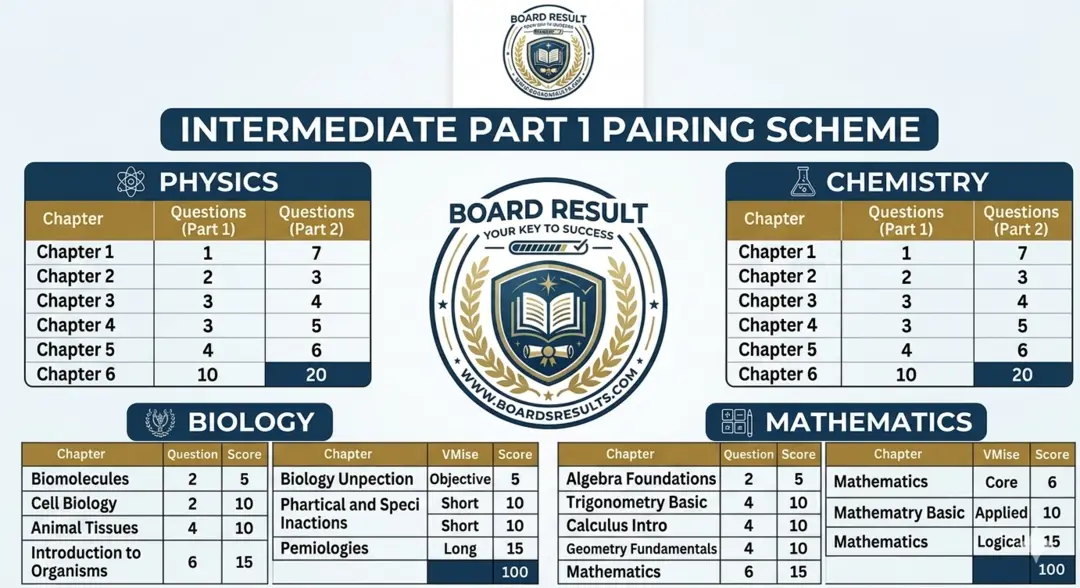
What Is a Pairing Scheme?
A pairing scheme is an examination blueprint issued by educational boards to guide students regarding the paper pattern. It specifies:
- The chapters included in the examination
- Distribution of short and long questions
- Marks allocation
- Pairing of chapters for subjective questions
- Important units for objective questions
The scheme enables students to prepare smartly rather than studying blindly without understanding the examination structure.
Importance of 1st year Pairing Scheme
The Intermediate Part 1 syllabus is depth and often challenging for students condition from matriculation to higher secondary education. 1st Year pairing scheme offers several advantages:
1. Smart Preparation
Students can focus on high-weightage chapters and manage their study time efficiently.
2. Better Understanding of Paper Pattern
It helps students know how questions are grouped and which chapters are paired together.
3. Reduced Exam Stress
A clear preparation strategy minimizes confusion and anxiety before examinations.
4. Time Management
Students can divide their study schedule according to marks distribution and chapter importance.
5. Improved Performance
By studying according to the scheme, students can maximize their chances of securing higher marks.
Structure of 1st Year Pairing Scheme
Although the exact pairing scheme may amount slightly among educational boards, the general structure remains similar.
Objective Section
The objective portion usually includes:
- Multiple Choice Questions (MCQs)
- Fill in the blanks
- True/False statements
- Matching columns
MCQs are often selected from all chapters, making complete syllabus coverage essential.
Subjective Section
The subjective section generally consists of:
Short Questions
- Students attempt a specific number of questions from different chapters.
- Questions are usually evenly distributed throughout the syllabus.
Long Questions
- Chapters are paired together.
- Students choose one question from a pair.
- Long questions may include derivations, explanations, numerical problems, or diagrams depending on the subject.
Subject-Wise Pairing Scheme For Intermediate Part 1
Physics
The Physics pairing scheme often includes:
- Numerical problems
- Theoretical explanations
- Derivations
- Diagrams and laws
Important topics usually include motion, vectors, force, work and energy, waves, and thermodynamics.
Chemistry
The Chemistry Pairing scheme commonly include:
- Chemical equations
- Conceptual explanations
- Numerical calculations
- Organic and inorganic chemistry concepts
Students should focus on understanding reactions and chemical principles rather than memorization alone.
Biology
The Biology Pairing scheme generally emphasizes:
- Diagrams and labeling
- Definitions
- Functions and processes
- Detailed explanations of biological systems
Conceptual clarity is essential for scoring high marks.
Mathematics
Mathematics pairing schemes are based on:
- Exercises
- Theorems
- Algebraic derivations
- Trigonometric identities
- Problem-solving techniques
Regular practice is the key to success in mathematics.
How to Prepare According to the Pairing Scheme
Study the Entire Syllabus
The pairing scheme should guide preparation, not replace complete study. Important questions may come from any chapter.
Focus on High-Weightage Chapters
Allocate more time to chapters carrying more marks.
Practice Past Papers
Past papers help students understand recurring patterns and important topics.
Prepare Notes
Short notes improve revision efficiency during exams.
Solve Numerical Problems Daily
For science subjects, consistent practice is essential.
Revise Regularly
Frequent revision strengthens memory retention and conceptual understanding.
Common Mistakes Students Make
Depending Only on Selective Study
Some students study only paired chapters and ignore the rest of the syllabus. This can be risky.
Ignoring Objective Preparation
MCQs cover the entire syllabus, so complete preparation is necessary.
Lack of Practice
Understanding theory without solving questions may lead to poor performance in exams.
Poor Time Management
Students often spend too much time on easy topics and ignore difficult but important chapters.
Role of Teachers and Educational Boards
Teachers play a vital role in helping students interpret the pairing scheme correctly. Educational boards issue schemes to ensure transparency and standard in examinations. Schools should provide proper guidance so students can benefit effectively from these schemes.
Conclusion
The pairing scheme for Intermediate Part 1 is an essential academic resource that helps students prepare strategically for board examinations. It provides clarity about paper patterns, chapter importance, and marks distribution. However, students should remember that the pairing scheme is only a guide, not a substitute for comprehensive study.
Success in intermediate examinations depends on consistent effort, conceptual understanding, regular practice, and smart preparation. By combining hard work with effective use of the pairing scheme, students can achieve excellent academic results and build a strong foundation for future studies.
You have tried your best, God willing, you will succeed.