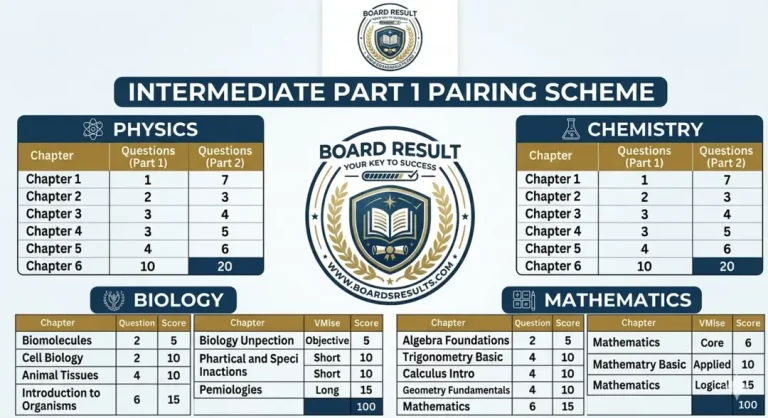
2nd Year Pairing Scheme
The Intermediate Part 2 examination is a significant academic achievement for students truth higher secondary education. 2nd Year pairing scheme is an essential tool that helps students understand the distribution of questions, marks allocation, and chapter-wise weightage in examinations. By studying the pairing scheme carefully, students can prepare more effectively and manage their time wisely during exams.
This article explains the concept of the 2nd Year pairing scheme, its importance, structure, and strategies for preparation.
What is a Pairing Scheme?
A pairing scheme is a planned arrangement of examination questions prepared by educational boards. It provides details about:
- Short questions
- Long questions
- Multiple-choice questions (MCQs)
- Chapter-wise distribution
- Marks allocation
- Question selection patterns
The purpose of the pairing scheme is to guide students regarding the most important areas of the syllabus and help them prepare in a systematic way.
Importance of the Pairing Scheme
1. Better Exam Preparation
The pairing scheme allows students to focus on important chapters and topics. Instead of studying randomly, students can prepare according to the marks distribution.
2. Time Management
Students can divide their study hours according to the weightage of chapters. Difficult or high-mark chapters can be given more time.
3. Understanding Paper Pattern
The pairing scheme provides insight into how the examination paper will be arranged. This reduces anxiety and increases confidence.
4. Smart Study Strategy
Rather than memorizing the entire syllabus equally, students can identify the most frequently asked topics.
Structure of 2nd Year Pairing Scheme
The pairing scheme generally consists of three major sections:
Multiple Choice Questions (MCQs)
MCQs are usually distributed across all chapters. They test conceptual understanding and quick thinking.
Short Questions
Short questions are designed to test definitions, formulas, concepts, and brief explanations. Students are usually required to answer a specific number from several given options.
Long Questions
Long questions require detailed explanations, derivations, numerical problems, or essay-type answers. These questions carry higher marks and demand complete understanding.
Subject-Wise Pairing Scheme Overview
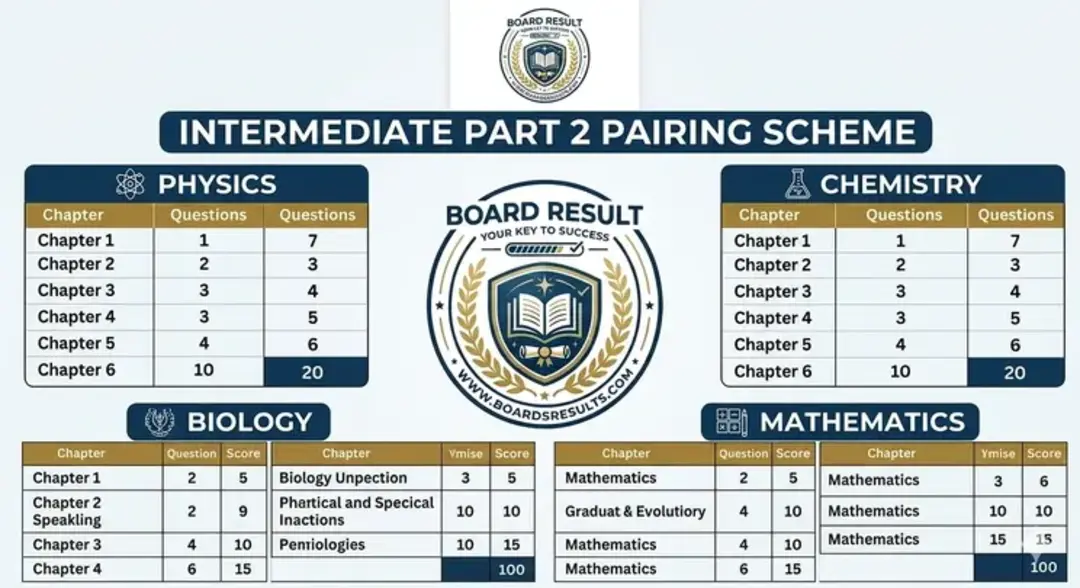
Physics
The Physics pairing scheme usually includes:
- Numerical problems
- Definitions and laws
- Derivations
- Conceptual questions
- Practical applications
Students should pay special attention to formulas and diagrams.
Chemistry
The Chemistry pairing scheme often focuses on:
- Chemical reactions
- Organic chemistry concepts
- Numerical calculations
- Definitions and short explanations
- Experimental procedures
Balanced preparation of theory and numericals is essential.
Biology
Biology papers generally include:
- Diagrams and labeling
- Definitions
- Detailed explanations
- Functions and processes
- Comparative questions
Students should focus on understanding concepts rather than rote memorization.
Mathematics
The Mathematics pairing scheme mainly covers:
- Theorems
- Derivations
- Algebraic problems
- Trigonometry
- Calculus and analytical questions
Practice is the key to success in mathematics.
Computer Science
Computer Science pairing schemes may include:
- Programming concepts
- Definitions
- Flowcharts
- Practical coding problems
- Theory-based questions
Students should combine theoretical study with practical programming practice.
Effective Preparation Strategies
Follow the Pairing Scheme Regularly
Students should keep a copy of the latest pairing scheme and use it while studying.
Prepare Important Chapters First
High-weightage chapters should be completed before less important ones.
Guess Papers
Guess Papers Help Students understand those questions which are repeated.
Practice Past Papers
Past papers help students understand repeated questions and examination trends.
Make Notes
Short notes, formulas, and summaries improve revision efficiency.
Revise Daily
Regular revision strengthens memory and improves confidence.
Attempt Mock Tests
Mock tests improve speed, accuracy, and time management skills.
Common Mistakes Students Should Avoid
- Ignoring low-weightage chapters completely
- Relying only on selective study
- Memorizing without understanding
- Skipping revision
- Not practicing numerical or practical questions
Balanced preparation is necessary for excellent performance.
Role of Teachers and Educational Boards
Teachers guide students in understanding the2nd Year pairing scheme and identifying important topics. Educational boards ensure fairness and transparency through properly designed pairing schemes.
The pairing scheme also helps maintain standardization in examinations and ensures that all sections of the syllabus receive proper attention.
Benefits of Pairing Scheme for Students
- Reduces examination stress
- Improves study planning
- Increases confidence
- Saves preparation time
- Enhances scoring opportunities
- Helps in focused learning
Students who use the pairing scheme effectively usually perform better in examinations.
Conclusion
The Intermediate Part 2 pairing scheme is an important academic guide that helps students prepare efficiently for board examinations. It provides a clear understanding of paper patterns, chapter importance, and marks distribution. By following the pairing scheme, students can organize their studies, improve time management, and achieve better results.
Success in examinations is not only about hard work but also about smart preparation. The pairing scheme serves as a roadmap that directs students toward effective and focused learning. With proper planning, regular practice, and consistent revision, students can confidently excel in their Intermediate Part 2 examinations.